
Arrest Records in Lamar County
Lamar County arrest records begin with the agency that takes a person into custody. That may be the Lamar County Sheriff's Office, Barnesville Police Department, Georgia State Patrol, or another authorized agency. Each keeps its own incident or arrest report. When the person is delivered to the county jail, detention staff open a separate intake file. The two records overlap, but they are not copies. The police report can hold the alleged facts, officer supplements, witnesses, and evidence references. The jail sheet focuses on identity, booking time, charges received at intake, bond, and custody status.
A booking is an accusation-stage event. It does not establish guilt. Prosecutors may file different counts, decline a count, or never open a court case. For that reason, a sound Lamar County arrest lookup ends at the court clerk whenever the outcome matters. The clerk's disposition, not the booking label, shows whether a charge ended in conviction, dismissal, acquittal, or another result.
Time also changes which office has the useful answer. The jail can confirm custody soon after intake, while an incident narrative may not be ready for three business days. A felony docket begins only after a filing reaches the clerk. GCIC may receive the final disposition later still. Searchers reconstructing one event should keep the agency number, booking number, and court case number distinct. Matching those identifiers is far safer than assuming every system updates at once.
Lamar Sheriff Records Counter
The Sheriff's Administrative Division handles sheriff reports, local criminal histories, and jail-created documents. Incident reports are not posted online. Staff ask that a report age at least three business days before a copy request. The official page lists counter help from 8:00 a.m. to 4:30 p.m.; the request form gives a narrower 8:30 a.m. to 4:00 p.m. window, so that narrower span is safest for a walk-in.
The official sheriff page below shows the local records channel.
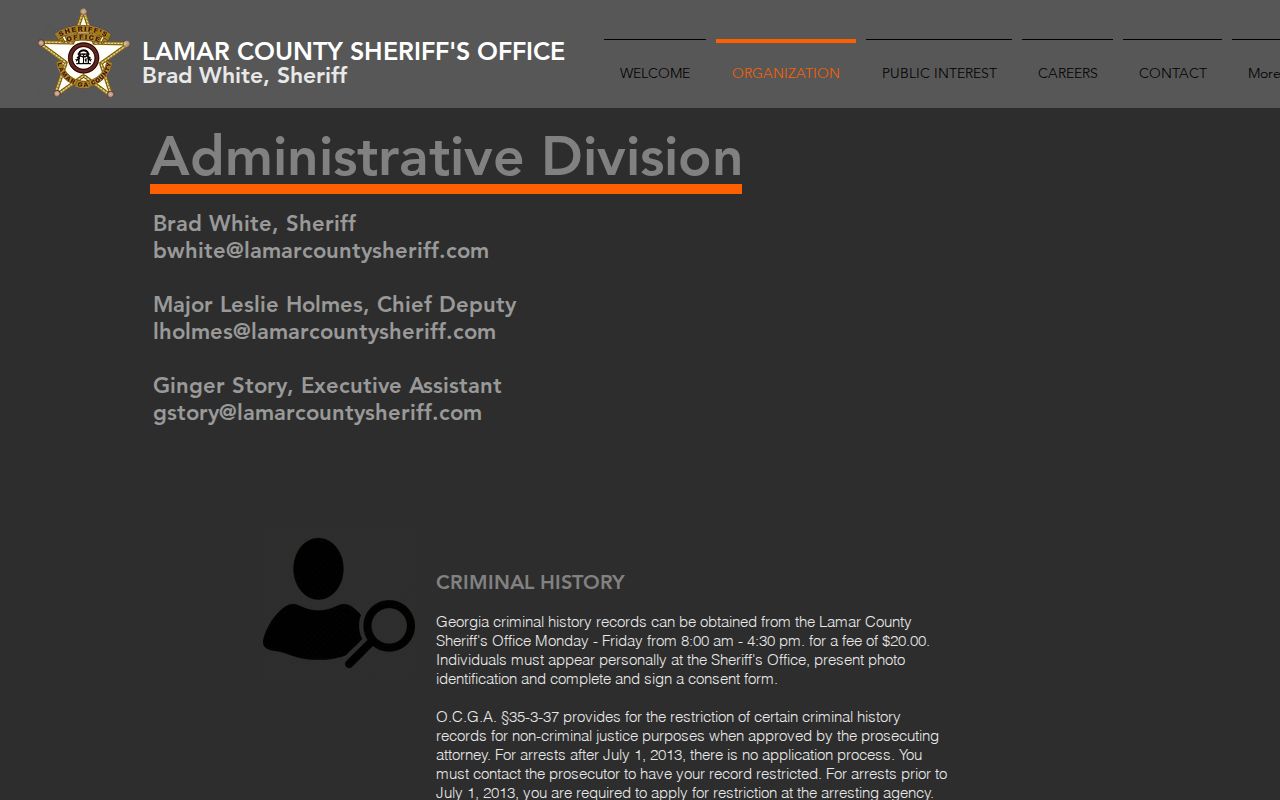
Its instructions matter because a caller seeking an incident report follows a different route from someone requesting an inmate information sheet.
Lamar County Sheriff Records
121 Roberta Drive
Barnesville, GA 30204
770-358-5377
general@lamarcountysheriff.com
Monday-Friday, safest form window 8:30 a.m.-4:00 p.m.
Requests may go in person, by email, fax at 770-358-5195, mail, or the sheriff's form. A mailed report request requires the case number, requester name, a self-addressed stamped envelope, and a $3 cashier's check or money order payable to the Lamar County Sheriff's Office.
Georgia agencies generally must respond to an Open Records Act request within three business days. That response may produce the record, state a lawful basis for withholding it, or give a timetable and expected cost. Ordinary paper copies can cost $0.10 per page. Search, retrieval, copying, and supervision labor may be charged after the first 15 minutes at the rate of the lowest-paid full-time employee able to perform the work. These are request-processing rules, not a promise that every arrest detail is public.
Lamar County Arrest Lookups
No verified official public booking-log search was located for Lamar County. The working route is phone, form, arresting agency, court, and state repository. Use the case number whenever possible, since a name alone can match the wrong person.
- Call jail operations at 770-358-5151 to ask about current local custody. A person may have been released or transferred.
- Submit the sheriff form and select “Inmate Info Sheet” for booking facts. Select “Incident Report” only when the sheriff originated the event.
- Request the narrative from Barnesville Police, GSP, GBI, or another named arresting agency when it owns the investigation.
- Check Lamar County court case records for filed charges and the disposition. Magistrate Court handles early warrant functions, while Superior Court holds filed felony matters.
- For a compiled Georgia history, use the sheriff's $20 in-person photo-ID and signed-consent process. After a state transfer, use GDC Find an Offender.
Note: A missing jail answer may reflect release, transfer, or a booking elsewhere, not proof that no arrest occurred.
Lamar Inmate Info Sheet
The sheriff's open-records form offers a precise tool for recent arrest research. A requester can select an Inmate Info Sheet, incident report, CAD report, 911 audio, or another named item. The form asks for the incident number, date and time, location, involved names, and other facts that help staff find the right record. Ask for the product needed rather than “all records.” A narrow request reduces search work and lets the custodian separate releasable material from protected details.
The form also shows that intake and delivery can occur by phone request or in person, with results sent by email, USPS, or pickup. Active investigative material, protected victim data, juvenile files, security information, and sensitive identifiers may be withheld or redacted under the Georgia Open Records Act. A requester may ask for the nonexempt portions that can be separated.
For example, a focused request might name a short incident time range and ask for the releasable incident report, booking sheet, CAD chronology, or 911 audio. Those are separate products. If the sheriff did not create the narrative, its staff can still hold the Lamar County jail intake sheet. The arresting agency remains the correct custodian for its own officer report.
Arrest Records: What They Contain
A Lamar County arrest file can span three custodians. The arresting agency records the alleged event, detention staff record intake, and the court records what prosecutors later file. Public availability varies by field and case status.
| Agency and case number | Identifies the arresting office and its report, often the best key for a copy request. |
|---|---|
| Arrest date and basis | Shows when and where custody began, alleged offenses, and whether a warrant was involved. |
| Booking number and time | Identifies the separate Lamar jail intake event. |
| Initial charges | Lists allegations presented at booking, which may change after prosecutor review. |
| Bond and custody status | Shows initial release terms, present housing, release, or transfer when available. |
| Fingerprint and photograph | Biometrics may be taken during qualifying bookings; local public mugshot display was not verified. |
| Court outcome | Appears in the clerk's later docket and disposition, not as proof within the arrest report. |
Report Versus Booking Sheet
An arresting-agency report and a Roberta Drive booking sheet answer different questions. The report explains the claimed reason for arrest and may include an officer narrative, witness accounts, evidence references, and the agency case number. The booking sheet documents the jail's work after transport: identity confirmation, property inventory, medical and security screening, biometrics, intake charges, bond, and housing or release.
| Record | Best source | What it answers |
|---|---|---|
| Incident or arrest report | Arresting agency | What officers alleged happened |
| Inmate information sheet | Lamar sheriff | What happened at jail intake |
| Filed criminal case | Trial-court clerk | What prosecutors charged and how court ended it |
| GCIC history | Authorized law-enforcement channel | Reported Georgia arrest cycles and dispositions |
If Barnesville Police, GSP, or GBI made the arrest, ask the sheriff only for the jail-created part. Route the narrative to the originating agency. That split prevents an accurate “not our record” response from being mistaken for no record at all.
Recent Lamar County Bookings
The Lamar County Detention Center receives people arrested by agencies across the county. It was built in 1992, has 152 beds, and reports 21 sworn jailers. No official public daily roster interface was confirmed. For a recent Lamar County booking, call the jail or request an Inmate Info Sheet. Do not rely on a commercial mugshot gallery.
The official jail-operations source provides context for the local booking process.
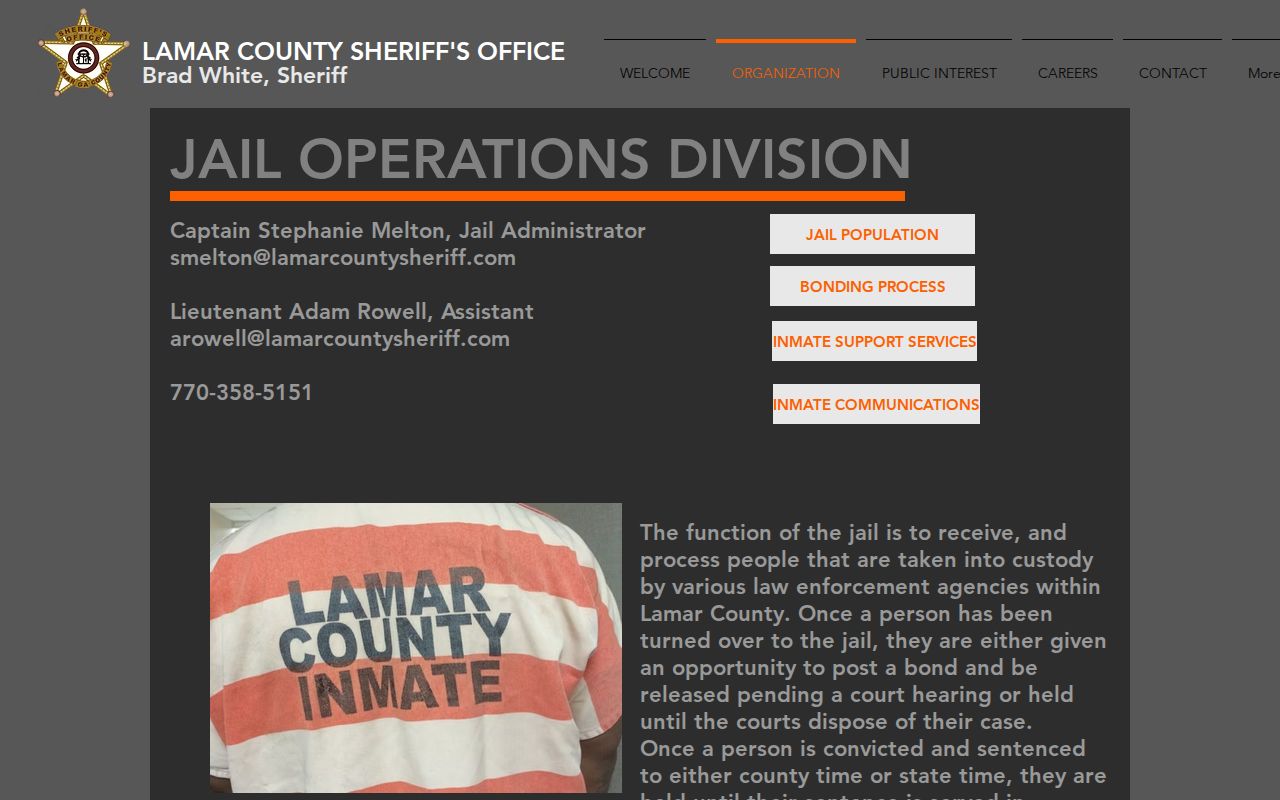
The jail record can confirm local intake, but it cannot tell whether a prosecutor filed the same charge or whether the case later ended.
Current custody: Call jail operations at 770-358-5151. Absence can mean release, transfer, or no Lamar County booking.
Release can follow bond, court order, completion of local time, dismissal, acquittal, or transfer. A name dropping from custody does not reveal which path occurred. Ask for release status, then locate the clerk's disposition.
On a bondable charge, bond may be posted day or night. The sheriff states a $13 taking-bond fee. Surety, transfer, and cash bonds follow different procedures, and a particular court order can limit the permitted type. Failure to appear can lead to a bench warrant, often with no bond. None of these custody events alone states whether the original charge ended in conviction.
Lamar Jail Contact Records
Housing and communication records begin only after intake. The sheriff's inmate support instructions describe visitation, scanned nonlegal mail, legal mail, and Pay Tel calls. These systems can help families maintain contact, but none proves the state of the criminal case. Calls may be monitored except privileged communications, and transfer timing is withheld for security.
The official inmate-support source illustrates those custody rules.
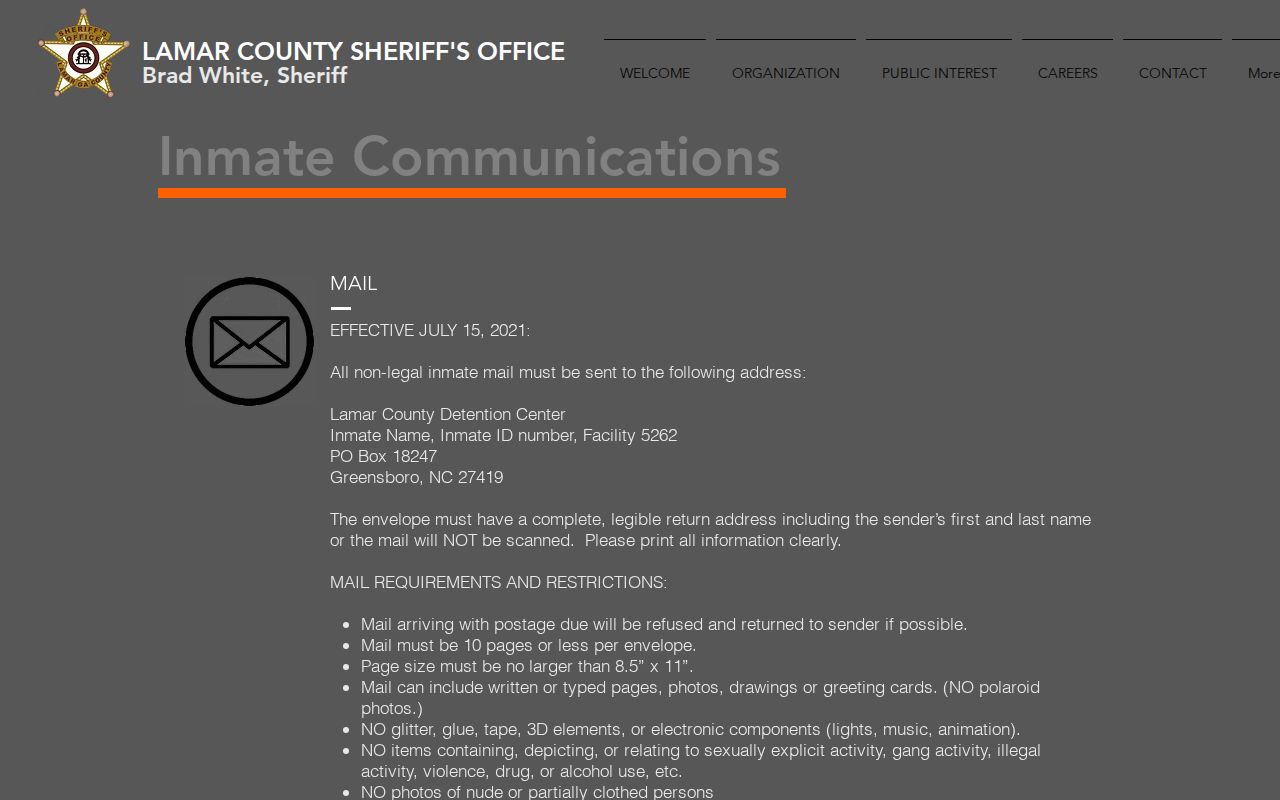
Use jail contact information for present housing questions, then use court records for charges and outcomes.
Lamar Arrests Reach GCIC
For a fingerprintable event, booking staff take fingerprints and a photograph, then transmit an arrest cycle to the Georgia Crime Information Center. Fingerprints help link the event to the correct person more reliably than a name search. They do not prove conviction. Courts, prosecutors, and custodial agencies later report dispositions, but a delay can leave an arrest looking unresolved.
When a self-review shows a missing or wrong outcome, obtain a certified Lamar County disposition and compare each count with the GCIC cycle. For arrests after July 1, 2013, GBI directs eligible restriction requests through the prosecutor. Older arrests follow the arresting-agency route. Georgia record restriction limits dissemination; it does not automatically erase every agency, jail, or court source.
Arrest Records vs Conviction Records
Booking charges and court charges can diverge. The comparison below keeps the sources and meaning separate.
| Arrest Record | Conviction Record |
|---|---|
| Created by the arresting agency and jail | Created by a court after a plea or finding |
| Shows that custody and booking occurred | Shows a judicial finding and final count |
| Lives with police and sheriff records | Lives with the clerk and reported state history |
| May end in release, no filing, or dismissal | Includes sentence and can be followed by appeal or relief |
Note: An arrest is not proof of guilt; verify every booking allegation against the filed case and final court disposition.